

What's new in Inspire?
Explore the latest features in your version of Inspire.
Contact us
-
Inspire 2026.1
Overview
Inspire 2026.1 delivers a major update across cloud processing, hardware integration, and inspection automation. This release introduces a redesigned point cloud architecture, enabling non-destructive workflows, improved performance, and expanded scalability for large datasets.
Additional investments include ATS800 targetless scanning integration, automation of inspection workflows, and modernization of the application platform to support improved responsiveness and future extensibility
- ATS800 targetless scanning integration
- Non-destructive cloud architecture
- Inspection workflow automation
- Platform modernization and scripting enhancements
Platform & Performance Improvements
- Migration to .NET 10
- Improved memory and runtime performance
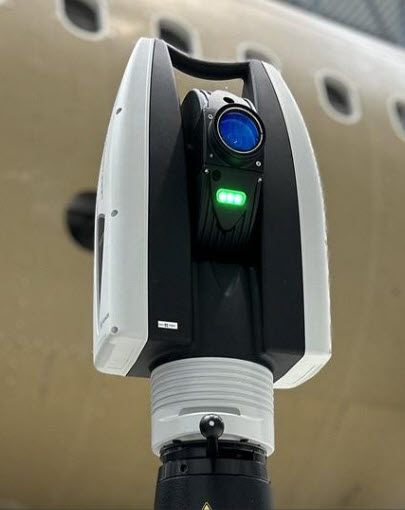
ATS800 Integration (Initial Support)
Inspire 2026.1 introduces initial support for the Leica ATS800 laser tracker, enabling targetless measurement workflows through integration with the OVC (Overview Camera).
Key Capabilities:
- Area and line scanning with a unified scan profile
- Selection of circles and slots as part of a Measure Perimeters action
- Expanded perimeter construction tools
- Scan into a unified cloud or directly into features
- OVC synchronization and automatic instrument discovery
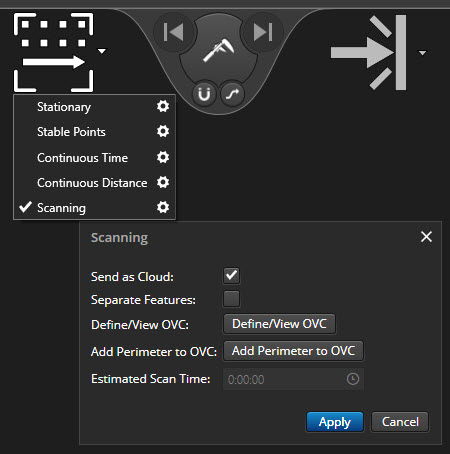
A Unified Scanning Profile Provides Direct Access to Scanning Workflows:
-
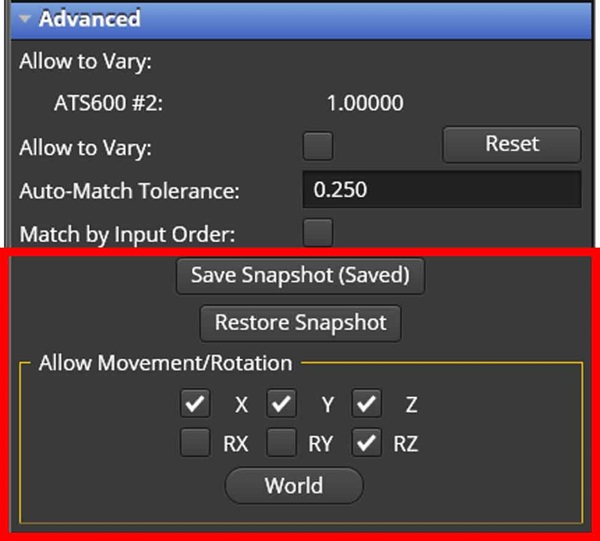
Legacy scan profiles (such as ATS600 ring/patch scans) have been removed and a single OVC scan profile standardizes all supported scanning interactions. This profile supports both area scans (closed perimeters) and line scans (open perimeters). Scans can be mapped directly into a single point cloud, or assigned to individual feature constructions during acquisition.
-
-
This significantly reduces user decision points during scanning and ensures consistent scan acquisition behaviour across all ATS800 workflows.
Measure Perimeters Action has been Expanded:
-
Integrates selection of nominal geometry (slots and circles) directly within the scan workflow. Circles and slots can be scanned directly using a cross line scan pattern. Additional improvements were made to perimeter construction using CAD edge selection, which make perimeter construction even easier.
Additional Instrument behaviour & Integration Improvements:
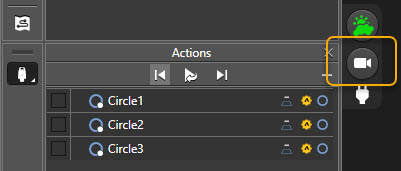
Automatic discovery of ATS800 devices on the network has been implemented and real-time synchronization with the OVC controller for perimeter definitions has been provided. This includes direct access to the OVC camera through a button at the side of the Actions:
Point Cloud Architecture Overhaul
One of the largest changes in Inspire 2026.1 is the redesign of the cloud architecture. This update changes how cloud data is organized, stored, processed, and edited, with the goal of reducing hierarchy complexity, preserving more source data, and making cloud workflows easier to understand and maintain. In tern, users spend less time managing data structures, benefit from improved storage efficiency, and can work more effectively with larger or more complex datasets.
Simplified Cloud Structure
Cloud Features and separate output clouds have been removed and replaced by a single unified cloud object. This simplifies the tree structure, makes cloud objects easier to find, and centralizes cloud display settings, filtering controls, and cloud-related properties in one place. In practical terms, the simplified structure reduces ambiguity about which cloud represents the active result and lowers the amount of tree navigation required to inspect or modify cloud settings.
-
Individual scans are now represented as scan passes that store raw instrument data. These scan passes serve as the source for processing and reprocessing operations rather than acting as preprocessed cloud. This creates a cleaner separation between source measurements and computed cloud results.
-

Raw Data Preservation and Non-Destructive Editing
Raw data preservation has been further improved in 2026.1. Editing cloud properties including voxel filtering, scanline filtering and deta deletion has been redesigned so these edits remain associated with the scan pass. In earlier versions, users could lose deletion work when reprocessing cloud data. No other metrology software offers this ability.
-
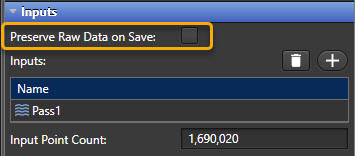
Raw, unfiltered scan data is now preserved by default, and the previous “Save Raw Measurements” workflow has been replaced with a per-cloud setting called Preserve Raw Data On Save. When raw scan data is stored in the project file or offloaded to disk, Inspire now compresses that data, typically reducing disk usage significantly. This gives users more control over whether raw data is written into the saved project and the benefit of improved performance at the same time.
Scanline filters are now available directly in the scan pass properties, and modifying those settings automatically reprocesses the original raw data.
-
A representative measured point is selected based on its relationship to the voxel average, helping ensure that stored voxel points remain true measured values rather than interpolated substitutes.
-
Scan passes now expose available metadata directly in their properties, including information derived from raw scan data and post-filtering stages. When a scan pass is selected, Inspire displays a sampled representation of its points in the graphics area to help visualize the source data behind the cloud.
-
Cloud editing operations such as point deletion and boundary removal are now non-destructive. Users can delete points or remove boundaries and later restore original data by using Restore Deleted Points in the scan pass properties.
Performance Improvements
Projects containing cloud data benefit from substantially improved performance in Inspire 2026.1. Load and save times can improve by up to 50%, memory usage and file size can in some cases be reduced by up to 50%, voxelization performance can improve by 30% to 235%, and rendering performance for large point cloud scenarios can improve by 5x or more.
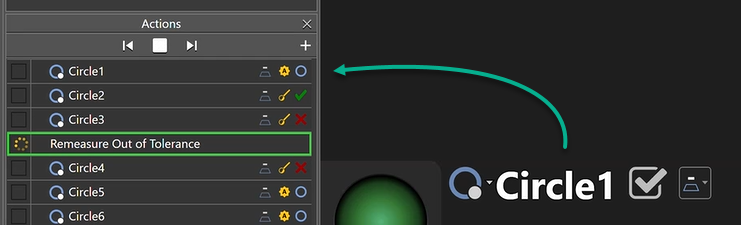
Remeasure Out of Tolerance Action
Inspire 2026.1 introduces a new Remeasure Out of Tolerance Action that automates the process of identifying, remeasuring, and validating failed inspection features. It then guides the user through a structured remeasurement workflow as follows.
When the action begins:
-
The system evaluates all measured features and identifies all out-of-tolerance features based on their tolerance state.
-
The first feature in the target list is set as the active measurement target.
-
The user is guided to remeasure that feature.
-
After completion, the workflow advances to the next feature in the list.
-
If any feature remain out-of-tolerance when the end of the list is reached, the workflow restarts at the beginning, repeating until all features pass, or the maximum retry count is reached.
This capability is designed to improve inspection efficiency, enforce repeatability, and reduce manual intervention during validation workflows. It ensures that all failed features are revisited in a consistent and repeatable manner.
Additional Improvements of Note
CAD Support Updates
Updated import support has been added for:
ACIS 2025 NX 2512 Revit 2026 AutoCAD 2026 Parasolid 38 SolidWorks 2026 Vector Visualization with Transparency Slider and Always On Top Option
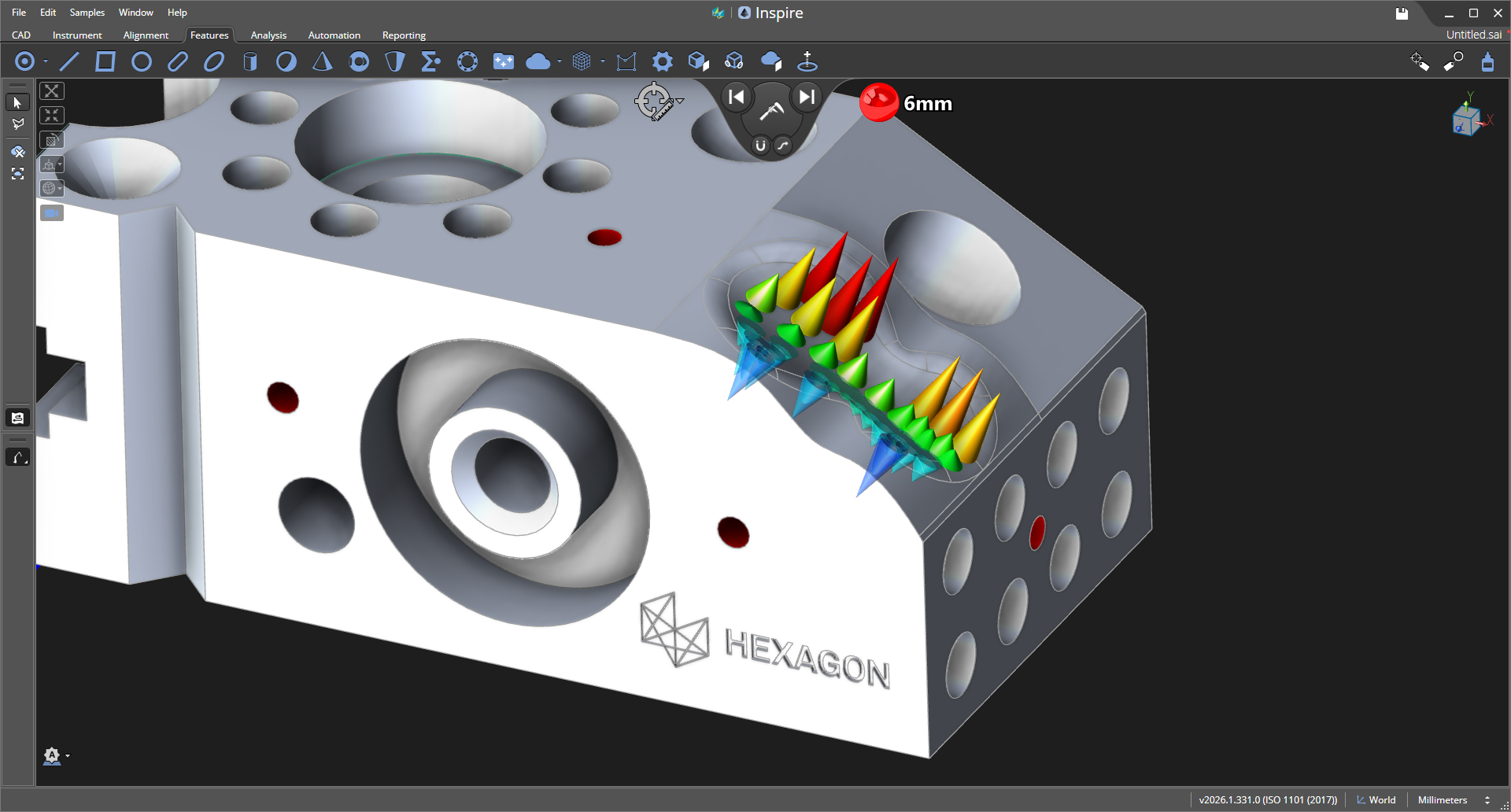
Comparison vector controls have been expanded with a transparency slider and an Always On Top option. These changes provide more flexibility when reviewing vector results in dense scenes or when overlays would otherwise be difficult to interpret.
A new transparency control allows users to dynamically adjust the opacity of comparison vectors.
-
Improves visibility when vectors overlap dense geometry or point clouds
-
Enables better inspection of underlying features while still observing deviation direction and magnitude
-
Reduces visual clutter in high-density inspection scenes
A new Always On Top toggle ensures vectors remain visible regardless of scene depth or occlusion.
-
Prevents vectors from being hidden behind geometry
-
Eliminates the need to rotate or isolate parts to view results
-
Improves workflow efficiency during inspection review
Create Cloud from Mesh
A new Create Cloud from Mesh capability allows users to generate a cloud directly from mesh vertices. This adds another path for converting geometry into cloud-based workflows without requiring original scan acquisition data.
Laser Tracker Simulator
The Laser Tracker Simulator has been updated with a more modern user interface aligned with the rest of Inspire. Simulation behaviour has also been expanded to include intensity variation, dropouts, surface holes, surface waviness, and more accurate scan rate simulation. Closing the simulator now disconnects the instrument automatically.
Python Scripting Enhancements
Inspire 2026.1 adds several scripting enhancements that make it easier to automate workflows and manipulate inspection objects. New capabilities include duplicating objects with IN_Duplicate, generating cardinal points with MakeCardinalPoints(), assigning nominals with SetNominal(), and creating remeasurement actions programmatically.
GD&T Improvements
The release also expands criteria-related scripting support. Non-GD&T and GD&T criteria are now handled through more clearly separated APIs, including the new IN_GDTCriteriaDetail data wrapper.
Additional Scripting Updates
Additional scripting improvements include temperature support for points and the ability to change script temperature units through IN_SetScriptUnits.
-
Inspire 2025.2
Using Perimeters in Inspire
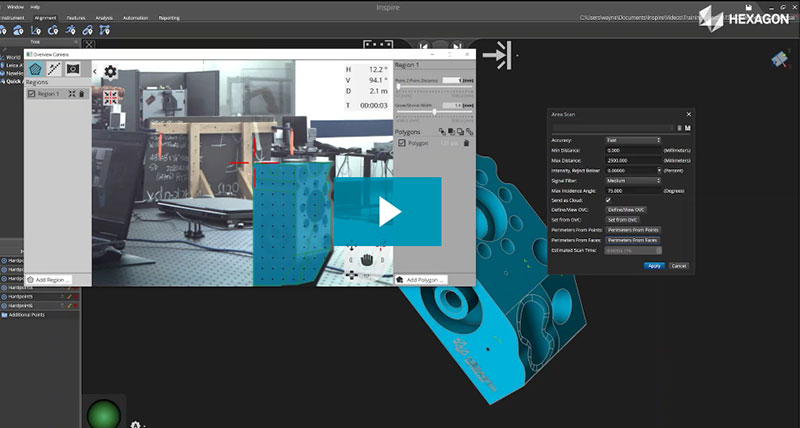
A Perimeter is a region to scan from an automated scanning device. Inspire has added Perimeter features to help plan for future inspections.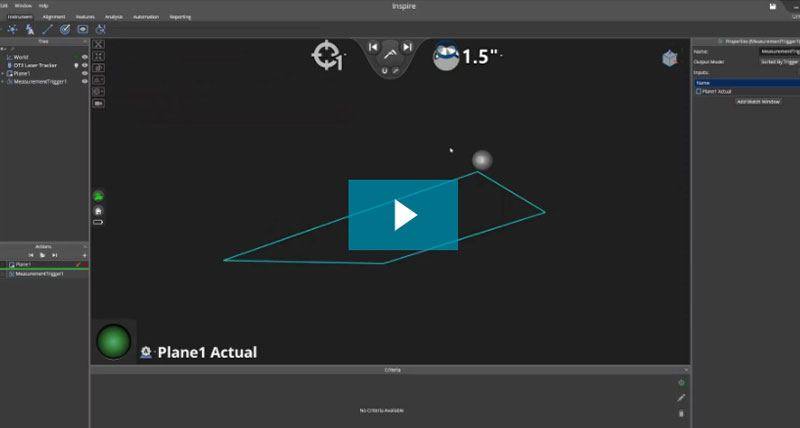
How to use measurement triggers
Measurements are triggered as an instrument's probe crosses the boundary of the specified surface.What’s New in Inspire 2025.2
134 Separate Enhancements & Improvements.
Updated CAD Import Format Support:
Autodesk Inventor 2026 Creo 12.4.0 Parasolid 37.1 Autodesk Navisworks 2026 IFC2 2.3.0.1, IFC4 4.3 STEP AP242
Ed1/2/3CATIA V5_6R2025 NX - Unigraphics Iterative RPS Alignment
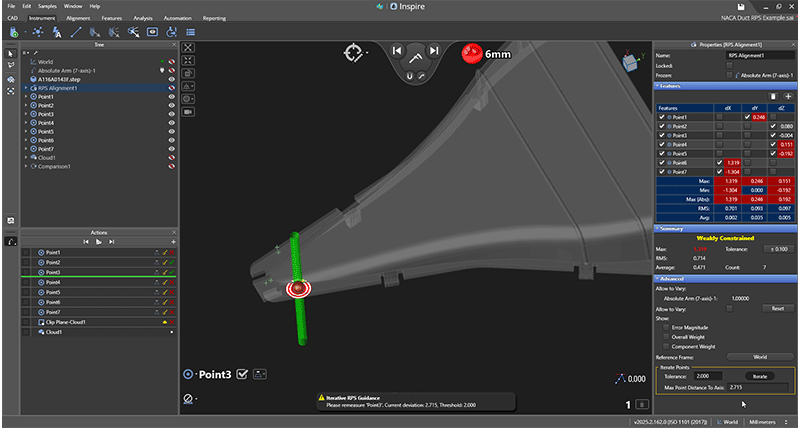
 This new capability provides user guidance during an iterate measurement process to ensure Datum Target Points are measured exactly where intended on a CAD model. This can greatly refine an RPS Alignment providing:
- Improved Alignment Results
- Simulate Physical Gage “pin” locations
- Manual or Action
- Settable User Tolerance
GD&T Datum Alignment
 This new alignment can be applied for from any callout, even if under constrained! To use the new GD&T Datum Alignment just select a Callout & the alignment for that callout will be applied for you. IT seamlessly handles datum shifts due to material modifiers on the datums and provides an ideal solution for reviewing and validating GD&T results.
GD&T & SPC Scripting Support

This version introduces scripting support for GD&T and SPC.
- Define Datum Features, Add GD&T Checks to feature’s Criteria, and modify existing GD&T Checks
- Add and Delete SPC Samples
Added Actions to Easily Repeat Inspections
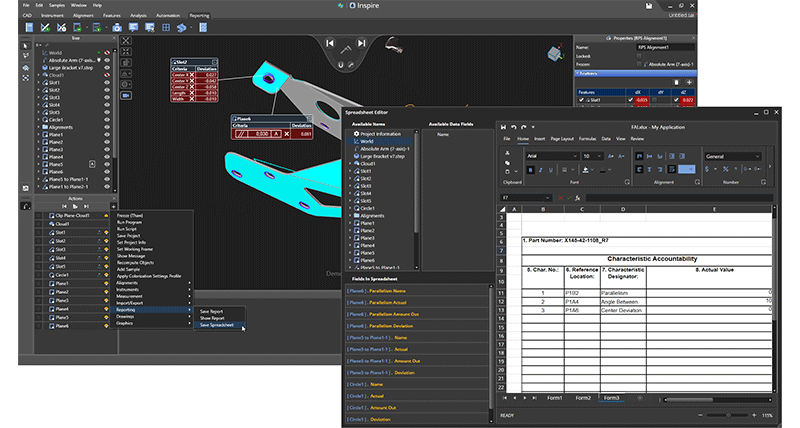
- Save Spreadsheet - This operation builds on Spreadsheet report functionality introduced in Inspire 2024.2. It automatically saves a spreadsheet within the actions.
- Export Criteria to CSV - Allows for automated exporting of criteria within the actions. Perfect for working with 3rd party tools
- Export Points to CSV - Similar to criteria export, but for the measurements. Perfect for working with 3rd party tools
Customize HUD Display Size
Set HUD for working close to display or across the factory floorTrackers and Arms
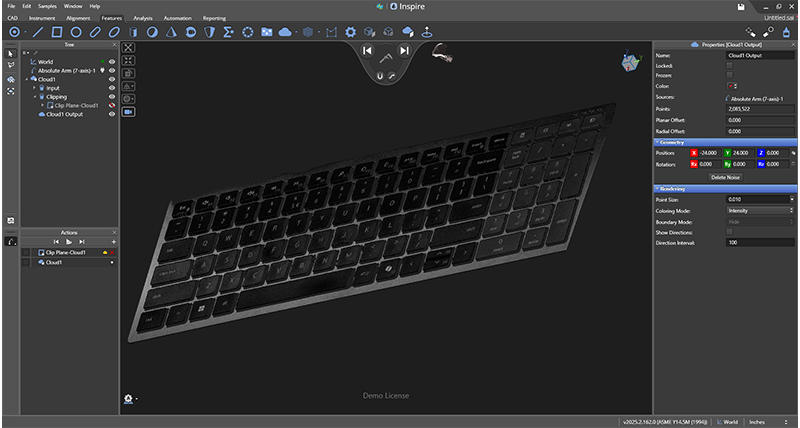 This RDS 6.6 version is supported in both Hexagon Absolute Arms and Leica AT960 with AS1 Scanner
This version provides Intensity, which is mapped to grey scale.A new display control is available under the default cloud controls for intensity colourisation.
Tracker Serial Number
The Laser Tracker Serial Number was sometimes not shown under Properties >> Hardware Details. This was due to the S/N being extracted from the TrackerName, which can be changed by the user. There is a separate TrackerSerial, from which this can be, and now is extracted.
HHScan Enhancements - Support for Hole Flash Capture technology
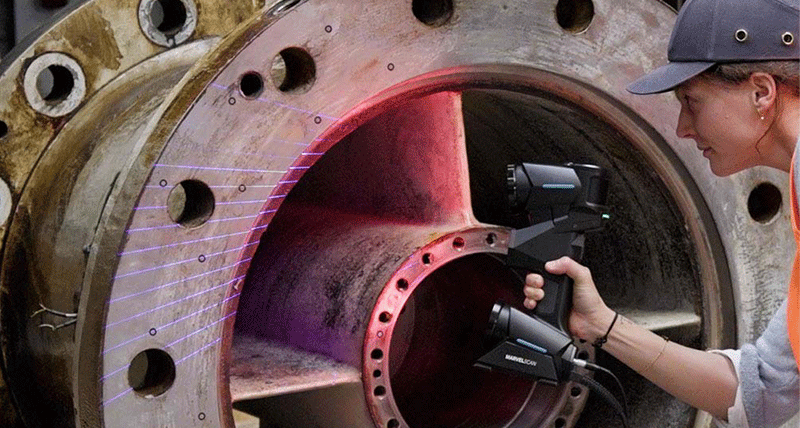
- Updated to support 2025.5 HHScan
- With Hole Flash Capture allows the simultaneous capture of multiple circular hole or slotted features is quickly and easily – Now fully supported in Inspire for Holes and Slots
Additional Changes
Visibility:
- Added the ability to hide/show objects by click-dragging across their eyeball icons in the tree.
- Show All" in the context menu has been renamed to "Show Selected and Children" to better reflect the intent of the command.
- "Show" and "Hide" context menus are now always available regardless of whether selected items are currently shown or hidden.
Performance Improvements
- Increased the speed of cloud noise deletion.
- Performance improvements for face filtering.
ISO 16610-71 Areal Surface Filtering
- Updated Surface Filtering logic improves performance.
- Point thinning enabled to further increase performance.
- Surface filter is now concealable from both the command window as well as the compute cancellation button at the bottom left of the status bar.
Actions:
- During playback, "Next" and "Previous" functions will no longer have an effect during "Run Program", "Run Script", and "Prompt for Datafield" actions.
- Improved support for stopping playback.
- 'Set Instrument Probe or Reflector' action filters selectable targets upon connection.
- Upon connection, users receive toast for any action that has invalid targets selected.
Spreadsheet
- Added context menu for creating 'save spreadsheet' play action.
- Drag and drop of a xlsx file into the graphics area imports that file into new spreadsheet.
Python Scripting
- IN_PromptForUserSelection, if active in a running script, will be cancelled if running script is cancelled.
- Add SPC support with IN_AddSPCSample, IN_DeleteSPCSamples and IN_SPCSample data wrapper.
- Redo of Run Script play action no longer hangs the play action or the application.
- Added Criteria ID to IN_CriteriaDetail.
- Added IN_AddDatumAlignment, which creates a Datum Alignment.
-
Inspire 2025.1
Inspire 2025.1 What’s New Hotfix
Improvements
- Slightly improved the precision of least squares circle fit orientations.
- Updated language translations.
Fixes
- When adding guide points for a Mesh to CAD alignment, the graphical markers on the mesh wouldn't update their position during the temporary "bucking" alignment. This has been fixed.
- For SPC, fixed an issue where changes to visibility in 'Control' would not be synchronized properly to samples.
- Fixed an issue with the quality of colorized meshes created from a comparison.
- When projecting points to CAD, when the points were farther away from the CAD, the projection time increased significantly. This has been fixed.
- Fixed an issue when duplicating some spreadsheets.
- Fixed an issue with renaming that would cause errors and crashing under certain conditions.
- Fixed an issue which prevented some report items from renaming when the object they report was renamed
- Center-to-center and center-to-axis vector groups for measured features were not recomputing if an alignment merely caused the features to transform. This has been fixed.
- Python Scripting
- Fixed an issue which could incorrectly show an error message about units mismatch when running a script from an action
- Fixed an issue where the Run Script action could cause subsequent actions to freeze
- Temporarily disabled automatic sweep cancellation. If you would like to make a change to a setting that incurs long-running recomputation, manually cancel the existing computation, then change the setting. Automatic sweep cancellation is expected to return in the next release.
Inspire 2025.1
The latest version of Inspire brings many new features and functions
RPS Alignment Improvements
In previous versions, errors in measuring a surface point on inclined surfaces would introduce errors in the RPS alignment, pulling the alignment away from the ideal position.
These errors are now automatically compensated, removing this influence from the fit. No user intervention is required.
Compensation is performed by comparing to a point along the nominal point’s surface plane, not to the nominal point itself.
Dynamic Excel Fields
- Open any XLSX-formatted Excel Spreadsheet for use as a template
- Drag/drop fields into a cell to dynamically extract live data
- Fields automatically update
- Use equations/conditional fields for complex behaviour
- Export spreadsheet from within Inspire
- Spreadsheet saves inside SAI file
- Useful for AS-9102 FAI or any other Excel
Improved Measured Geometry Support
- Measured geometry (e.g. from the Hexagon Handheld 3D Scanner) now imports into feature input buckets
- New construction method, “Measured Geometry”, is used, which simply duplicates the input geometry to make the feature’s actual
- This enables setting nominals on these features and using measured geometry in alignments
- Measured geometry can also be set as the nominal for a feature if desired
- Note: Properties of measured geometries (e.g. radius) cannot be edited
Dynamic Perimeters
- Can be created from any number of point-reducible objects (points, circles, etc.), CAD faces, or other perimeters
- Recompute automatically when necessary
- Can be Open or Closed
- Can be Additive or Subtractive to support Boolean operations (combinations/cutouts)
CAD Edge Curves
- Curves can now be extracted from CAD using “Extract from CAD”
- Resulting curves are projectable: can be used in comparisons
- Those comparisons can be used in relationship alignments
Line/Curve Offset Handling
- Lines and Curves now have an “Offset Handling” option
- Allows you to decide whether to ignore offsets or compensate using planar offsets when projecting to a line or curve
Theme Specific Colours
- Custom Colours are now Theme-Specific (for more visual contrast)
- Simply define custom colours with a given theme active
- Drawings will now always use the light theme colours to ensure proper contrast on a light (printed) background
- Object colours can always be overridden explicitly
Areal Surface Filtering
- Surface features now support ISO-16610 Surface Filtering
- More rigorous outlier rejection (see spec for details)
-
Inspire 1.4.41.0
- Extract features from multiple CAD faces and partial surfaces
- New display options for dimensions and the graphic window
- Added a new feature intersector operation
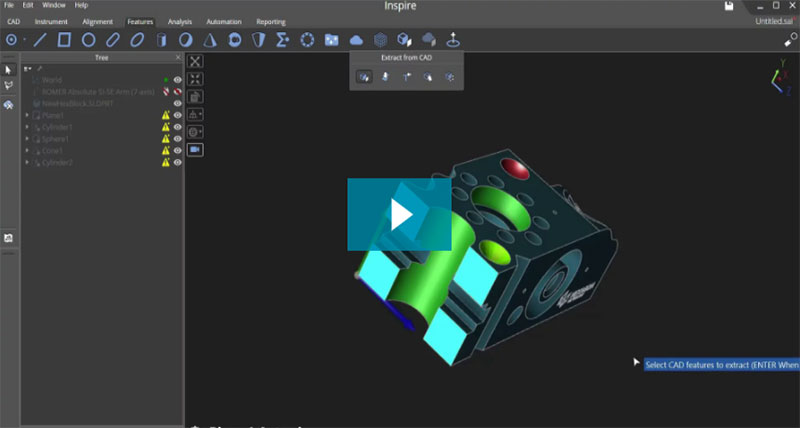
Enhanced CAD feature extraction
Extract features and organic surfaces using multiple CAD faces. Inspire more intelligently visualizes nominal features to match CAD faces.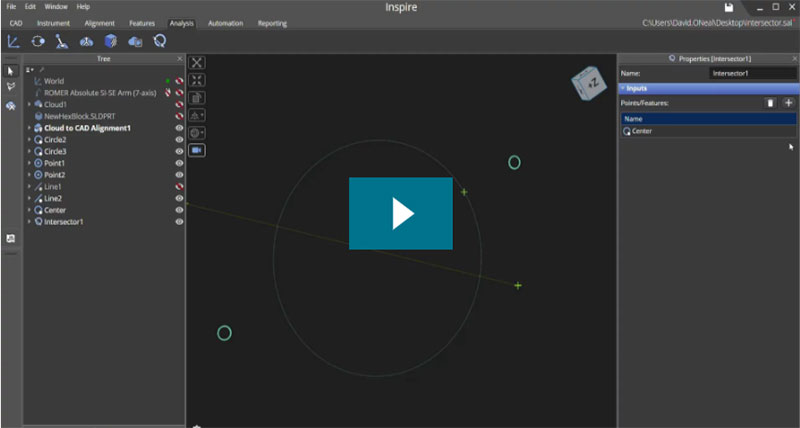
New Intersector feature
The Intersector feature now lets Inspire users create multiple intersection points from two features.
-
Inspire 2024.2
What’s New in Inspire 2024.1
This latest version of Inspire brings many new updates.Real-time Meshing
- When enabled, a real-time mesh will be automatically created when scanning
- Can be enabled or disabled for individual cloud features in their properties
Statistical Process Control
- Basic SPC Capabilities/Improved Connection to Nexus Metrology Reporting
- Added support for statistical reporting across multiple samples
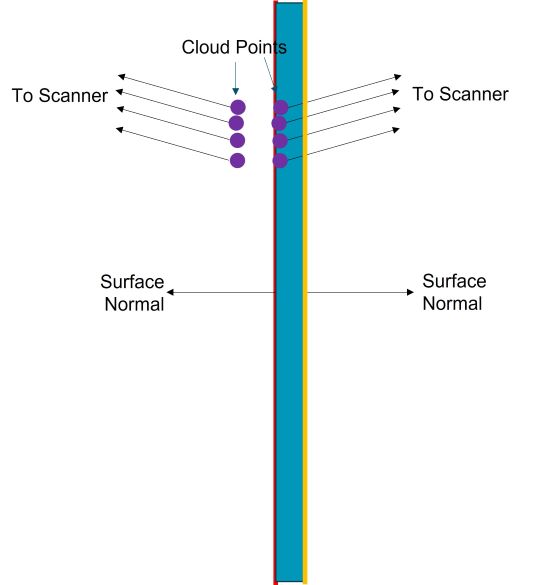
Projection Normal Matching
- Projection support for thin parts
- Previously, points always projected to closest face
- With projection normal matching, cloud directions determine which face is used for projection
Simulated Measurement
- Generate data without measuring
- Simulate scanning or probing measurements on CAD models, faces, or features
Vector Group Improvements
- Improved visual control
- Vector groups can now be assigned a visual length and/or position offset to help improve the positioning or visibility of vectors
And much more!
-
Inspire 2024.2
What’s New in Inspire 2024.1
This latest version of Inspire brings many new updates.Real-time Meshing
- When enabled, a real-time mesh will be automatically created when scanning
- Can be enabled or disabled for individual cloud features in their properties
Statistical Process Control
- Basic SPC Capabilities/Improved Connection to Nexus Metrology Reporting
- Added support for statistical reporting across multiple samples
Projection Normal Matching
- Projection support for thin parts
- Previously, points always projected to closest face
- With projection normal matching, cloud directions determine which face is used for projection
Simulated Measurement
- Generate data without measuring
- Simulate scanning or probing measurements on CAD models, faces, or features
Vector Group Improvements
- Improved visual control
- Vector groups can now be assigned a visual length and/or position offset to help improve the positioning or visibility of vectors
And much more!
-
Inspire 2024.1
What’s New in Inspire 2024.1
This latest version of Inspire brings many new updates.Real-time Meshing
- When enabled, a real-time mesh will be automatically created when scanning
- Can be enabled or disabled for individual cloud features in their properties
Statistical Process Control
- Basic SPC Capabilities/Improved Connection to Nexus Metrology Reporting
- Added support for statistical reporting across multiple samples
Projection Normal Matching
- Projection support for thin parts
- Previously, points always projected to closest face
- With projection normal matching, cloud directions determine which face is used for projection
Simulated Measurement
- Generate data without measuring
- Simulate scanning or probing measurements on CAD models, faces, or features
Vector Group Improvements
- Improved visual control
- Vector groups can now be assigned a visual length and/or position offset to help improve the positioning or visibility of vectors
And much more!
-
Inspire 2023.3
Inspire brings many new features to 2023.3, including:
- Inspire 2023.3 is now NIST certified
- Inspire 2023.3 geometry fitting is now certified by NIST in accordance with ASME B89.4.10-2000 and NISTIR 5686.
- See https://hexagon.com/company/divisions/manufacturing-intelligence/software-certificates
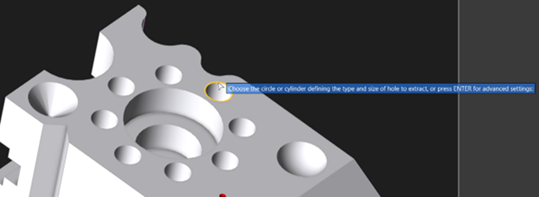
- Faster Multi-Hole Extraction from CAD
- Extract Multiple CAD Features has been renamed to Extract Holes from CAD and moved to the Features tab.
- Now you can select which faces on the CAD model to extract from:
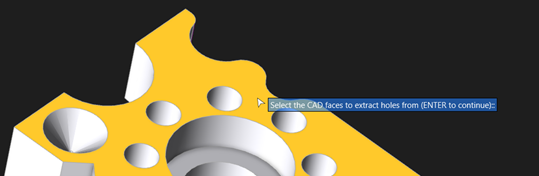
- Choose an existing hole to define the size, or use the (traditional) advanced dialog:
- Now you can select which faces on the CAD model to extract from:
- Extract Multiple CAD Features has been renamed to Extract Holes from CAD and moved to the Features tab.
- Cylinder Fit – Exhaustive Search
- Added Use Exhaustive Search option for cylinder fits.

- Outlier Rejection
- Options for Auto/On/Off
- Auto: On for clouds, off for probed points

- Face-specific Comparisons
- When creating a comparison, pick individual CAD faces to only compare to those faces. Or pick the entire CAD model from the tree.
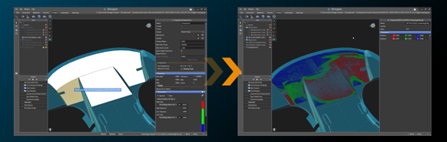
- When creating a comparison, pick individual CAD faces to only compare to those faces. Or pick the entire CAD model from the tree.
- Inspire 2023.3 is now NIST certified

-
Inspire 2023.2
Inspire brings many new features to 2023.2, including:
- Enhanced feature extraction – there are now more ways to analyze your feature extraction parameters and inputs
- Extraction cloud – the generalized region of cloud data being sampled
- Ringband cloud – the focused area that is set with the offset and bandwidth values in the extraction parameters
- BestFitPoints cloud – the resulting points being used for the geometry fit
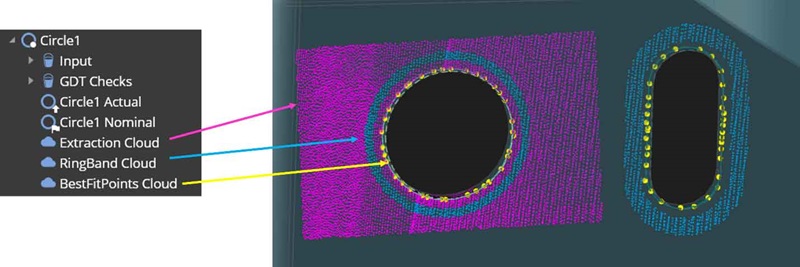
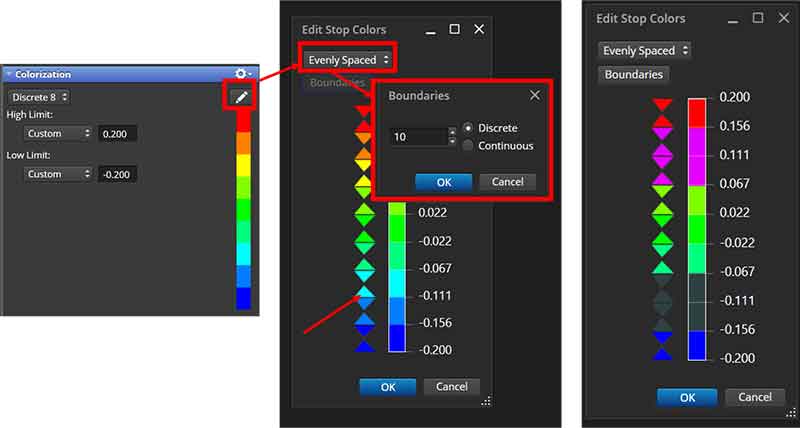
- Custom color bars – you can now customize the colour segments in a colorbar
- 6 degrees of freedom control for alignments – you can now control all six degrees of freedom in a Best-Fit Points to Points alignment
- Enhanced feature extraction – there are now more ways to analyze your feature extraction parameters and inputs

-
Inspire 2022.2
Inspire 2022.2 brings numerous memory, performance, and functionality improvements.
To improve performance, the way you scan and store cloud data is completely rewritten.
Expect increased speeds for scanning and processes with point clouds by parallelizing operations, making algorithms more efficient and avoiding unnecessary copy of data under the hood.
In production, this means you can scan a part with 5 – 7 scan passes in about 15 seconds. Where it used to take about a minute to process the data into a full scan, it now takes 20 seconds.
Many operations are two to three times faster, including Alignments and Feature extractions.
Some operations are up to 10x faster, including scanning large files, and selecting and deleting large sections of cloud data. Deleting sections of a point used to take twenty seconds, now take only two.
Major improvements include:
- To improve performance, the way you scan and store cloud data is completely rewritten
- Improved speeds for scanning and operations with point clouds by parallelizing operations, making algorithms more efficient and avoiding unnecessary copy of data under the hood.
- Many operations are 2 – 3 times faster, including Alignments and Feature extractions
- Some operations are up to 10 times faster, including scanning large files, selecting and deleting large sections of cloud data
-
Inspire 2022.1
- New functionality enabling a password security upgrade. Password protect job files and lock features.
- Comparison enhancements – add a comparison that reverses the direction / magnitude of deviations, and a comparison to save colorization settings and changing the default colorization selection.
- New features including the addition of a construction method for calculating a diameter and location where two cones intersect, updates to analysis tools, offsetting along a normal, instrument jumping, cloud to cloud alignments, added GD&T support for ASME and ISO, and more, all designed to continue making Inspire more robust and easier to use.
Enhanced CAD feature extraction
New Intersector feature
-
Inspire 1.3.154.0
- Create features and dimensions from individual cross sections
- Enhanced feature callout visualizations and value display logic
- Added functionality to the ATS600 interface and updated camera views
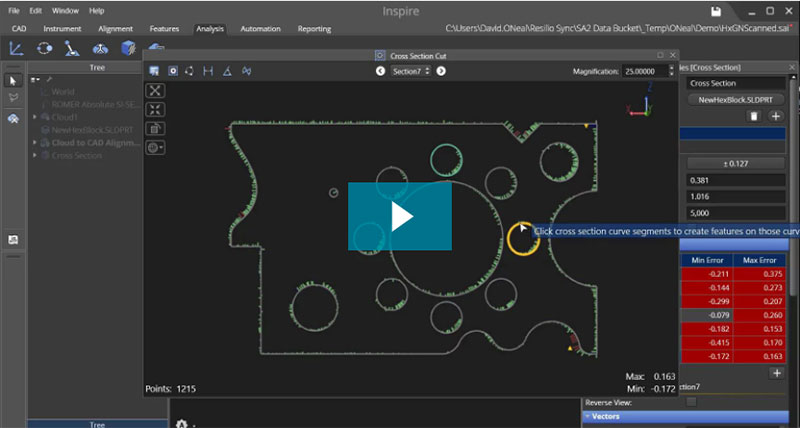
Further cross section analysis
Inspire now allows users to perform more in depth analysis of a single cross section. Extract features and create dimensions directly from the cross section view.