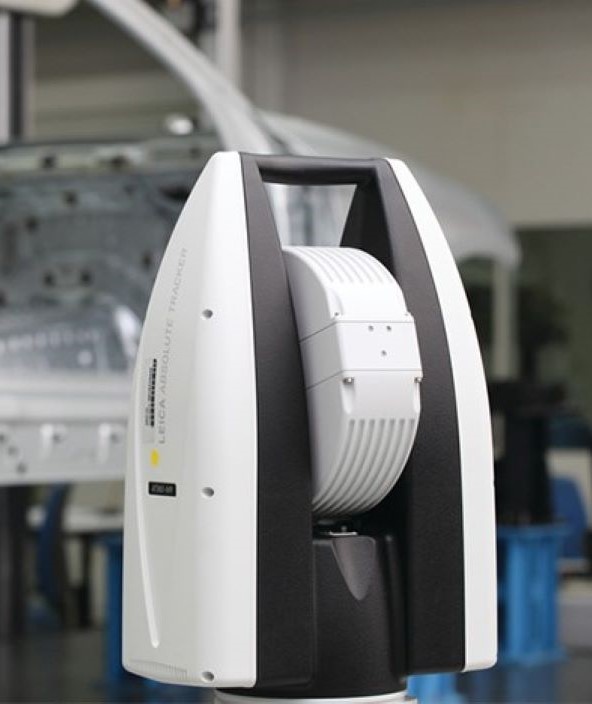


SETIS speeds up and safeguards the assembly of the world’s largest telescope with Leica Absolute Tracker ATS800
The direct scanning laser tracker unveiled in 2025 – the Leica Absolute Tracker ATS800 from Hexagon – combines laser tracking and contactless measurement to improve productivity significantly in large-scale manufacturing and assembly operations.
This device now lies at the heart of an ambitious astronomy project: the Extremely Large Telescope (ELT) built by the European Southern Observatory (ESO), the largest and most powerful optical telescope ever built. Currently taking place in the Atacama Desert in Chile, at an altitude of almost 3,000 m, the assembly of its various segments requires adjustments accurate to within a millimetre.
This is where the ATS800 comes in – deployed by metrology expert SETIS (Degaud Group), based in the Rhône-Alpes region – delivering measurements accurate to around 30 micrometres in record time, all while guaranteeing the complete safety of the on-site teams responsible for checking the mechanical interfaces of a structure almost 40 metres tall.
Facilitating the assembly of a large-scale structure with micrometre precision
The first intergovernmental astronomy organisation in Europe and the world’s most productive astronomical observatory, ESO brings together 16 member states. Founded in 1962 and employing around 700 people, its main objective is to provide astronomers and astrophysicists with state-of-the-art instruments for observing the skies.As such, it is currently building the ELT in Chile, the largest optical telescope in the world, featuring a recordbreaking 39-metre primary mirror. Entrusted to the ACe consortium led by Cimolai, a leading company in the design and construction of very large steel structures, the construction and subsequent assembly of its moving structure – made up of an azimuth structure and an elevation structure – requires, among other things, perfect alignment of its rotation axes. To achieve this, sensors will measure the position of each segment relative to its neighbours, while actuators mounted on the back will adjust its position and shape.
“Any deviation would compromise pointing stability”, says Pascal Martinez, head of dome assembly and main structure integration (Dome and Main Structure – DMS) for the ELT. “That’s why validating the rotation axes is a non-negotiable step before every new assembly phase. To ensure compliance with specifications throughout the project, rigorous metrology monitoring is absolutely essential”.
Indeed, the tolerances required on this project – due for delivery by 2027 – are extremely strict. In concrete terms, on the “altitude tracks” (two 29-metre-diameter cylinder sections), the form deviation must not exceed 30 micrometres over 500 mm, equivalent to about a third of the thickness of a human hair. Their overall cylindricity must also be maintained to within a few millimetres.


SETIS’s expertise combined with a cutting-edge metrology solution
To meet this challenge, SETIS – an industrial metrology expert for over 30 years and a longstanding Hexagon partner – was commissioned by ESO to carry out independent counter-measurements to confirm the assembly’s compliance, initially remotely, drawing on the on-site measurements taken by Cimolai’s teams.A subsidiary of the Degaud Group, SETIS is a recognised leader in dimensional metrology and industrial measurement in France. Regularly working with organisations such as CERN and on international projects such as ITER or ALMA (also run by ESO), SETIS has 85 employees, including 19 metrology experts, with the main mission of supporting its clients on large-scale projects. It thus acts as a trusted third party, overseeing subcontractors and checking the telescope’s measurements.
In December 2025, an on-site intervention by the company was set to validate a critical phase of the assembly. SETIS drew on its in-depth knowledge of Hexagon’s metrology solutions and chose to deploy the Leica Absolute Tracker ATS800 for the first time in France. Unlike contact-based systems, this long-range laser tracker uses non-contact technology and “TruePoint” position recognition, enabling measurements to be taken without a reflector.
“The ATS800 very quickly emerged as the ideal solution for verifying the ELT’s assembly”, says Gaël Archambeau, Head of Metrology at SETIS. “It combines fast, precise scanning capabilities with advanced surface-recognition instruments. Its 40-metre range is a major asset on a project of this scale”.
"The ATS800 very quickly emerged as the ideal solution for verifying the ELT’s assembly."
Gaël Archambeau
Head of Metrology, SETIS
Increased precision and safety for teams
Hexagon’s instrument marks a genuine step forward: unlike previous non-contact lasers, which were unable to precisely locate edges, the ATS800 automatically identifies edges and circles through advanced signal analysis. This capability makes it possible to check complex geometries without direct human intervention, avoiding the need to deploy rope-access technicians on the structures, while SpatialAnalyzer supports the inspection and analysis of the resulting measurement data against project requirements.Another key advantage of the ATS800 is the ability to use spheres, which are less expensive than traditional reflectors. As the instrument can take measurements from any angle, registration within the vast volume of the dome is greatly simplified: once the spheres are installed, the ATS800 is located in under 2 minutes, compared with more than 20 minutes for another type of laser tracker.
SETIS also made the most of the laser’s exceptional range to check the geometry of the telescope’s cylinders from a distance of 35 metres. The company thus validates – continuously over two 12-hour periods – any variations in the rotation axis against the specification of a few millimetres.
With the ATS800, SETIS was able to measure thousands of points with unmatched speed and precision, while SpatialAnalyzer enabled efficient processing, analysis, visualisation, and reporting of the large measurement datasets generated during the verification process. And with good reason: Hexagon’s solutions made it possible to complete the operation in around 60 minutes, five times faster than with a traditional laser tracker – all without using a lifting platform. This remote measurement thus removes the risks for operators, who no longer need to work 40 metres above the ground.
“The initial results confirm compliance with the 30-micrometre tolerances and already highlight all the benefits the ATS800 can bring to ESO. There is no doubt that the Observatory will call on Hexagon’s technologies for the next assembly phases”, concludes Gaël Archambeau.