

Enhancing precision and performance at NASCAR Brazil with parametric digital models
Hexagon leverages HYPERSCAN, MARVELSCAN and Geomagic Design X to create digital twins of the 2026 Mustang and Camaro.
Founded in the US 70 years ago, NASCAR is a world-famous stock car racing series. In the competition drivers race on oval tracks and road courses in vehicles specifically built for this purpose. Today, several countries host NASCAR races, including Brazil.
All cars competing in NASCAR Brazil need to follow strict technical rules that guarantee a level-playing field. A lot of effort goes into ensuring each car complies, so NASCAR Brazil sought to speed up technical standardisation and inspection using digital models.
For support in this project they partnered with Hexagon, a leader in digital reality solutions. With the aid of HYPERSCAN and MARVELSCAN handheld 3D scanners and reverse engineering software Geomagic Design X, Hexagon created highly accurate 3D models of the new 2026 Mustang and Camaro.
All cars competing in NASCAR Brazil need to follow strict technical rules that guarantee a level-playing field. A lot of effort goes into ensuring each car complies, so NASCAR Brazil sought to speed up technical standardisation and inspection using digital models.
For support in this project they partnered with Hexagon, a leader in digital reality solutions. With the aid of HYPERSCAN and MARVELSCAN handheld 3D scanners and reverse engineering software Geomagic Design X, Hexagon created highly accurate 3D models of the new 2026 Mustang and Camaro.

“The partnership with Hexagon took us to a new level,” Thiago Marques, CEO at NASCAR Brazil, says. “The technology brings precision and agility to measurement, enabling us to ensure there is no variation between cars. We can just focus on what is most important. It’s going to revolutionise motorsports, not just at NASCAR, but in general.”

Car verification
Digital 3D models have the potential to enhance efficiency on several fronts. The vehicles featured in the races are custom-built by the different teams participating in the race, but they must also meet certain criteria. The chassis, engine, and bodywork are standardised. The adjustments that can be made to the suspension geometry, aerodynamic tuning, and wheel alignment are strictly regulated.With 3D models, the technical team could carry out deeper and more precise analyses than with traditional technical documentation, as well as reduce inspection and homologation time. Additionally, using the 3D models would enable NASCAR Brazil to align with NASCAR US excellence guidelines which ensures fairness and high performance.
The digital twins were created by a highly skilled technical team from Hexagon in several stages:
1. Digitalising the car body
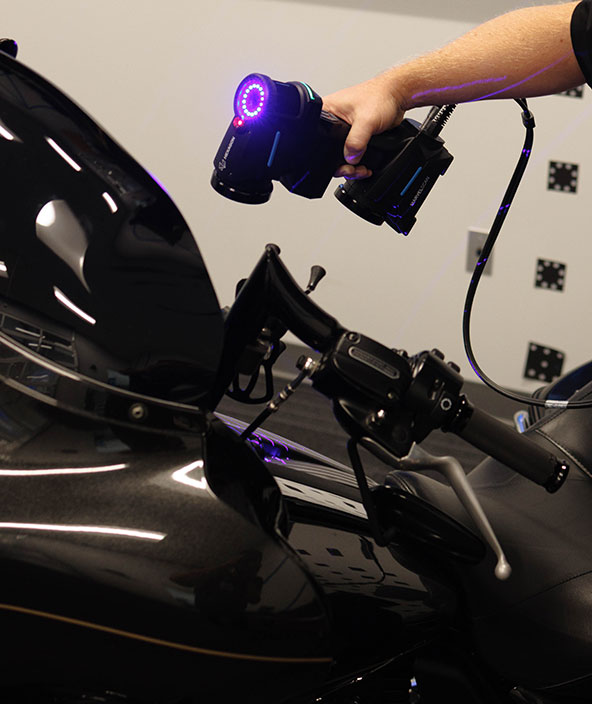
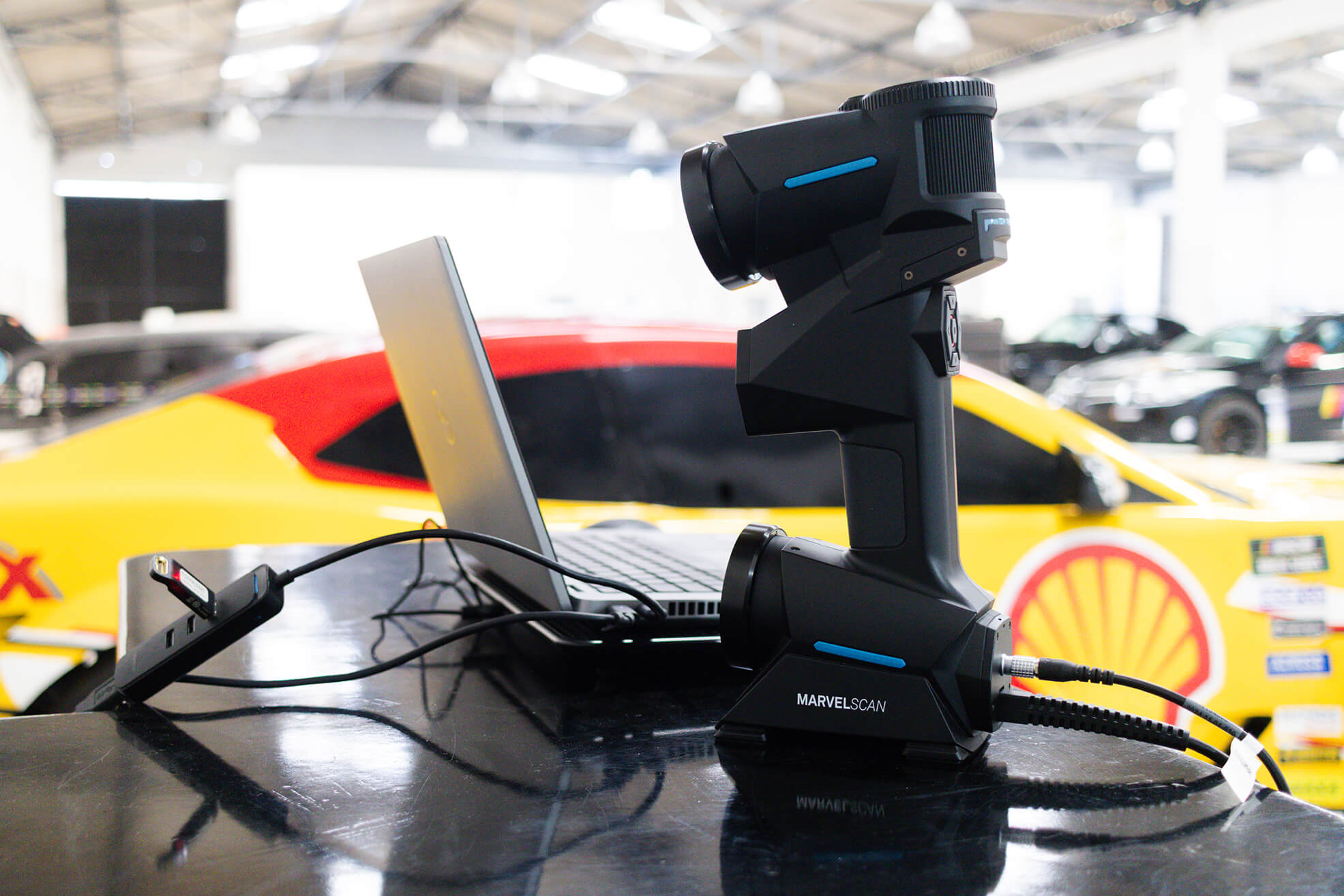
To capture the complete geometry of the Mustang and Camaro 2026 with high precision and speed, the team used a HYPERSCAN smart optical tracking 3D scanner. The result was a dense and detailed point cloud of the entire external surface. For small parts and critical components, they used MARVELSCAN, a patented target-free handheld scanner with built-in photogrammetry. This enabled the team to digitalise the suspension details, mounting points, specific aerodynamic elements, and other crucial parts that require an even higher level of detail and precision.
2. 3D reverse engineering
Scan data is the foundation of precise digital models. Hexagon’s application engineer collected the point clouds of the car and loaded them into Geomagic Design X where he created the models in a process called reverse engineering. The result were fully editable 3D CAD models of the vehicles.
3. Creating digital twins
The models of the car body and the components were consolidated into a complete digital twin of each vehicle. These models will serve as the basis for NASCAR Brazil to verify the dimensional compliance of the cars with regulations, compare different vehicles, and keep a faithful digital record for future consultations and analyses.
Scan data is the foundation of precise digital models. Hexagon’s application engineer collected the point clouds of the car and loaded them into Geomagic Design X where he created the models in a process called reverse engineering. The result were fully editable 3D CAD models of the vehicles.
3. Creating digital twins
The models of the car body and the components were consolidated into a complete digital twin of each vehicle. These models will serve as the basis for NASCAR Brazil to verify the dimensional compliance of the cars with regulations, compare different vehicles, and keep a faithful digital record for future consultations and analyses.

The benefits of digital twins
The digitalisation project has opened the doors to significant efficiency gains. CAD models of the cars allow NASCAR Brazil to perform compliance checks quickly, accurately, and with a complete digital documentation. Inspection is more efficient and more agile, while technical disputes can be resolved faster.“The Digital Twin project represents a significant advancement for NASCAR Brazil’s engineering sector,” Gustavo Bansho, Automotive Engineer at NASCAR Brazil, says. “With highly accurate CAD models, comparisons between car bodies become possible, as well as the detection of even the smallest variations between them.”
The future of motorsport
This project is a milestone in the application of advanced digitalisation technologies in Brazilian motorsport. By providing digital twins of the 2026 Mustang and Camaro cars, Hexagon solved a critical compliance challenge and empowered NASCAR Brazil to drive innovation and excellence in the world of competitive sports.For more information on how Hexagon can help revolutionise your business, contact us.